 Akelius Residential Property AB
governance
governance targets
corruption and bribery
- aim for zero cases of corruption
corporate culture
- achieve one hundred percent training participation on Code of Conduct and anti-corruption
governance policies
governance structure chart
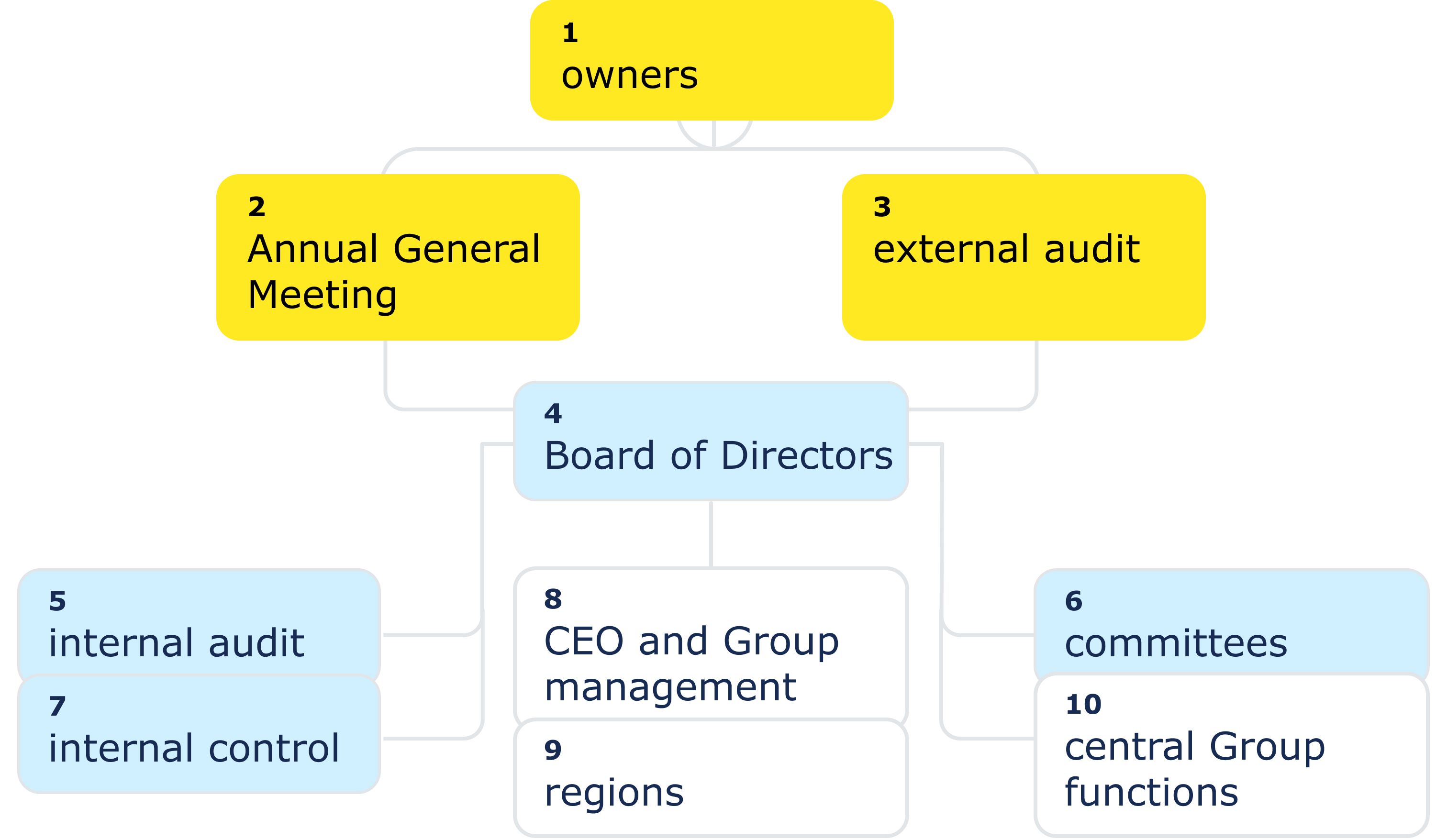
1. Akelius’ owners
The company's ultimate owner is the charitable Akelius Foundation, which controls over 99 percent of the shares and votes through Akelius Apartments Limited.
2. Annual General Meeting
The General Meeting is the Akelius’ highest decision-making body, through which the shareholders influence the company’s affairs.
The Annual General Meeting appoints the Board and the auditors, adopts the income statement and balance sheet, passes resolutions regarding the allocation of Akelius’ earnings, the discharge of liability, and changes to the Articles of Association.
3. external audit
According to the Articles of Association, the Annual General Meeting shall appoint at least one but not more than two auditors.
The appointed auditors shall audit the annual accounts, the consolidated accounts, the subsidiaries’ annual accounts, and the administration by the Board and the CEO.
4. Board
The Board is appointed by the Annual General Meeting for the period up to the end of the next Annual General Meeting.
According to the Articles of Association, the Board consists of a minimum of three and a maximum of seven members, with a maximum of two deputies.
The Board’s overall task is to be responsible for the organization and administration of operations and for the financial reporting.
The Board is also responsible for establishing systems for governance, internal control, and risk management.
Find the composition of the Board here.
5. internal audit
The function reports to the Board.
The Board annually sets a risk-based plan for the internal audit team to implement, ensuring it focuses on the right areas.
6. committees
The Board has appointed an Audit Committee consisting of three members.
The Audit Committee prepares the Board’s work on quality assurance of the financial reporting process, including significant accounting issues.
The committee is also responsible for monitoring management's work regarding internal control, property valuations, tax management, risk, and corporate governance issues.
The Head of Group Accounting is the committee's secretary and participates in all meetings.
The external auditors also attend all meetings.
The Board established the areas of responsibility for the Sustainability and Construction Committee.
The committee meets quarterly and prepares proposals for the Board related to construction and sustainability matters.
One central topic is the review of energy and sustainability.
7. internal control
The Board has the overall responsibility for the internal control of the corporate financial reporting.
The purpose of internal control of financial reporting is to ensure that the reporting is reliable and that the financial statements are prepared in accordance with IFRS and comply with applicable laws and regulations.
The risk assessment is continuously updated to include changes that significantly affect the internal control of financial reporting.
The most significant risks identified are misstatements in the financial reporting, valuation of the property portfolio and financial assets, deferred tax and other taxes, interest-bearing liabilities, and asset misappropriation.
8. CEO and Group management
The Board delegates the day-to-day responsibilities for the Group’s management and financial reporting to the CEO.
The Board appoints the CEO and annually establishes an instruction that regulates the division of work and responsibilities between the Board and the CEO.
The CEO reports to the Board regularly regarding the Group’s development in relation to the established governing documents.
Find more management information here.
9. regions
The operation consists of three regions.
London, Paris, and Berlin are part of the European region.
Washington D.C., New York and Boston are included in the US region.
Toronto, Montreal, Ottawa, and Quebec City are included in the region of Canada.
The regional managers are responsible for the profitability in their respective regions.
This includes responsibility for property management, lettings, upgrades, purchases and sales, property valuations, and accounting in subsidiaries.
10. central Group functions
The organization is supported by the central Group functions.
Central Group functions include Group accounting, treasury, technology, and business development.
data protection
To ensure legal compliance, prevent data breaches, and protect tenants and staff, Akelius conducts data protection training for all staff.
ESG reporting standards
Akelius follows the Corporate Sustainability Reporting Directive and the European Sustainability Reporting Standards.
Climate change, energy efficiency, tenant and employee health and safety, and business ethics are core priorities identified through double materiality assessment.
To reduce ESG risks and attract responsible investment, Akelius has improved governance, enhanced data controls, and expanded training on related topics.
culture
Akelius fosters a professional, collaborative environment built on trust, honesty, accountability, and continuous improvement. The focus is on delivering results through teamwork, innovation, and respect.
Akelius values diversity, sustainability, and integrity.
Code of conduct
- is the basis of Akelius' business activities
- determines Akelius success as a long-term, sustainable business
- promotes excellence, integrity, and sustainability as the Akelius corporate culture
- ensures compliance with laws and regulations in all operating countries
- aims at conducting business with honesty and integrity
- promotes environmental and social sustainability
The Code of Conduct applies to everyone acting on behalf of Akelius, including employees, Board members, management, and consultants.
Akelius ensures that employees read and respect the Code of Conduct.
All staff are trained annually on the Code of conduct.
whistleblower process
To maintain transparency and accountability, the whistleblower channels provide a secure way for staff to report unethical or illegal activities without fear of retaliation.
The whistleblower policy ensures that all reports are investigated thoroughly and addressed appropriately.
Find more information on the whistleblower process here.
anti-corruption policy
The anti-corruption policy expands and explains the Code of Conduct.
It guides Akelius employees on how to be honorable.
Acceptable gifts that are either given or received must fulfil specified requirements.
Akelius employees may never offer or accept any kind of benefit from government representatives.
Akelius employees may never knowingly use a current Akelius contractor or supplier of construction material or services for personal purposes.
An annual anti-corruption policy test is mandatory for all Akelius employees.
consequences of non-compliance
Akelius maintains a record of any incidents related to corruption or bribery.
Internal audit investigates all incidents.
The company takes disciplinary action, which may include termination of employment, to prevent future occurrences.
Akelius collects data from multiple sources, such as the whistleblower channels and reports from local management.
All reported incidents are reviewed to determine whether they constitute a potential breach.
Possible incidents are identified, such as expenses claimed without proper justification, conflicts of interest that were not declared, and gifts received above the allowed limit.
These incidents are reviewed to check compliance with internal policies and legal requirements.